Have you ever wondered why Koreans “eat” their minds when they make a decision? The idiomatic phrase 마음을 먹다 meaning is one of the most essential expressions for anyone looking to sound natural in Korean. Whether it’s a life-changing resolution or a simple daily choice, this phrase carries a unique weight of determination.
In this guide, we’ll dive into the 마음을 먹다 meaning in English, explore its cultural nuances, and provide practical examples to help you master this versatile expression.
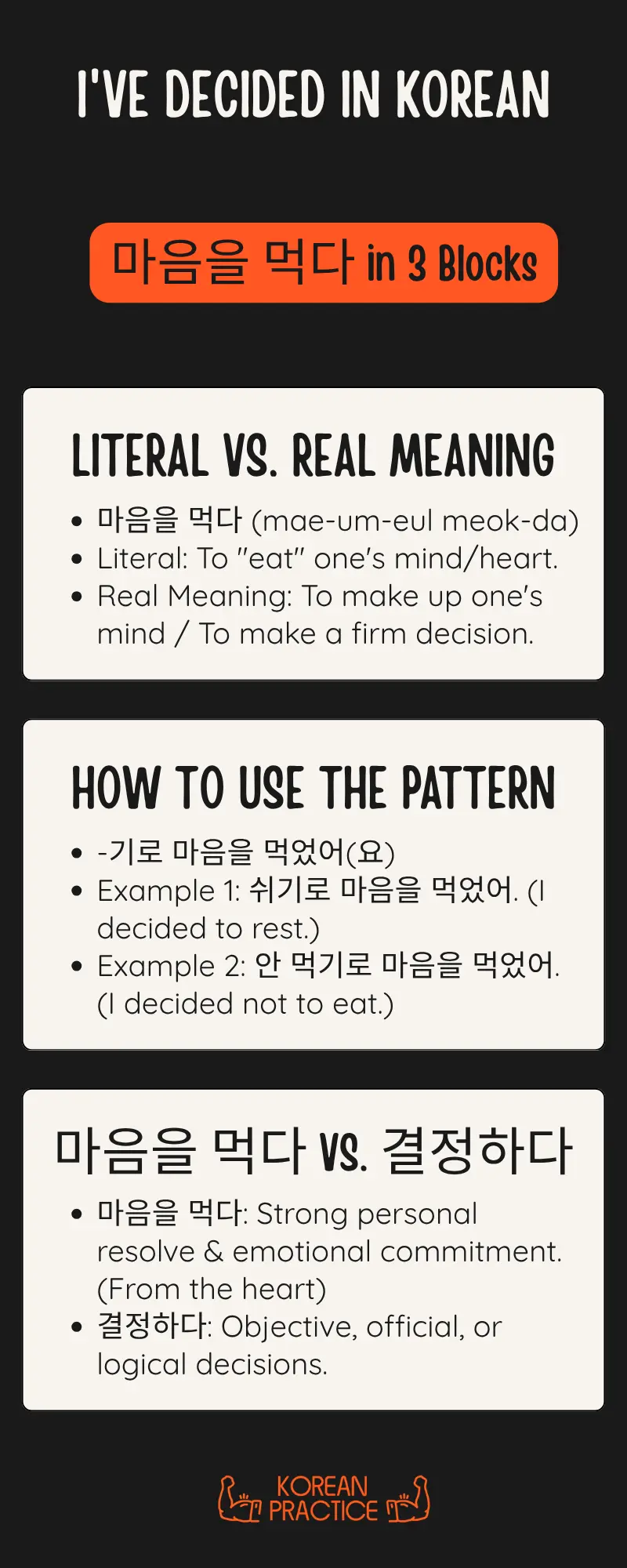
Table of Contents
The Literal vs. Metaphorical Meaning
To truly understand the 마음을 먹다 meaning, let’s look at the two words that form it:
마음 (Maeum): Heart, mind, or feelings.
먹다 (Meokda): To eat (metaphorically meaning “to take in” or “to set”).
Together, it implies “consuming” a thought until it becomes a firm part of you. It’s more than just a logical choice; it’s about aligning your heart with your actions.

When to Use This Expression
You can use 마음을 먹다 in various contexts where a level of commitment is involved:
Making a firm resolution to change a habit.
Deciding to overcome a difficult challenge.
Committing to a new journey (like learning Korean!).
Practical Practice: 마음을 먹다 Example Sentences
Seeing the phrase in action is the best way to learn. Here are a few ways to use a 마음을 먹다 example in real-life situations.
Simple Daily Decisions
Even small choices can involve “setting the mind” when you want to emphasize your intent.
Original Korean Sentence
오늘은 집에서 쉬기로 마음을 먹었어.
Pronunciation Guide
오느른 (o-neu-reun) 지베서 (ji-be-seo) 쉬기로 (swi-gi-ro) 마으믈 (ma-eu-meul) 머것써 (meo-geot-sseo).
Meaning and Context
오늘 (today) 은 (my topic is today) 집 (home) 에서 (at) 쉬 (to rest) 기로 (to (decide)) 마음을 먹 (to make up my mind) 었 (past tense) 어(I’m telling you casually).
Grammar
* -기로 마음을 먹었다: to decide
English Translation
I decided to rest at home today.
Literal Translation
(I) decided to rest at home today.

Expressing Excitement & Intent
When you finally stop hesitating and take action, this phrase perfectly captures that “Aha!” moment.
Original Korean Sentence
드디어 가고 싶었던 콘서트 티켓을 사기로 마음을 먹었어!
Pronunciation Guide
드디어 (deu-di-eo) 가고 (ga-go) 싶었던 (si-peo-tteon) 콘서트 (kon-seo-teu) 티켓 (ti-ket) 을 (eul) 사 (sa) 기로 (gi-ro) 마음을 (ma-eu-meul) 먹었어 (meo-geo-sseo)!
Meaning and Context
드디어 (finally) 가고 싶었던 (wanted to go) 콘서트 (concert) 티켓 (ticket) 을 (my object is a ticket) 사 (to buy) 기로 (to (decide)) 마음을 먹 (to make up my mind) 었 (past tense) 어 (I’m telling you casually)!
English Translation
I’ve finally decided to buy the concert tickets I wanted so badly!
Literal Translation
(I)’ve finally decided to buy concert ticket (I) wanted to go!
Did You Eat in Korean? Why This Greeting Means More Than Food
Resisting Temptation (Firm Resolve)
Deciding not to do something also requires a strong mind.
Original Korean Sentence
다이어트 때문에 디저트를 안 먹기로 마음을 먹었어.
Pronunciation Guide
다이어트 (da-i-eo-teu) 때무네 (ddae-mu-ne) 디저트를 (di-jeo-teu-reul) 안 (an) 먹끼로 (meok-ggi-ro) 마으믈 (ma-eu-meul) 머것써 (meo-geot-sseo).
Meaning and Context
다이어트 (diet) 때문에 (because of) 디저트 (dessert) 를 (my object is dessert) 안 (not) 먹 (to eat) 기로 (to (decide)) 마음을 먹 (to make up my mind) 었 (past tense) 어 (I’m telling you casually).
English Translation
I decided not to eat dessert because of my diet.
Literal Translation
(I) decided not to eat dessert because of diet.
Do You Speak English in Korean? 9 Easy Ways to Ask (With Examples)
Overcoming Hesitation
For major life decisions that require long consideration, this is the most natural expression to use.
Original Korean Sentence
오랜 고민 끝에 유학을 가기로 마음을 먹었어요.
Pronunciation Guide
오랜 (o-ren) 고민 (go-min) 끄테 (kkeu-te) 유하글 (yu-ha-geul) 가기로 (ga-gi-ro) 마으믈 (ma-eu-meul) 머것써요 (meo-geot-sseo-yo).
Meaning and Context
오랜 (a long time of) 고민 (consideration) 끝에 (at last) 유학 (to study abroad) 을 (my object is studying abroad) 가 (to go) 기로 (to (decide)) 마음을 먹 (to make up my mind) 었 (past tense) 어요. (I’m telling you polite and friendly).
Grammar
끝에: at the end of/ after.
English Translation
After much thought, I’ve decided to study abroad.
Literal Translation
After long time consideration, (I)’ve decided to go study abroad.
2 배가 아프다 Meanings : Physical Pain & Jealousy
Cultural Insight: The Heart of the Matter
Understanding the 마음을 먹다 meaning reveals a lot about Korean culture. Decisions are rarely seen as purely logical; they involve the 마음 (heart). When you “eat your mind,” you are gathering your internal energy and determination to follow through with your word.
Blind Date in Korean (Sogaeting) → Learn the word, the rules, and what to expect.
Expanding Your Vocabulary: Synonyms
While 마음을 먹다 meaning in English covers most “decisions,” you might encounter these similar terms in formal settings:
결심하다 (Gyeolsim-hada): To resolve (Formal/Academic).
다짐하다 (Dajim-hada): To vow or pledge to oneself.
각오하다 (Gago-hada): To brace oneself for a challenge.
Mastering the Reflex with KoPra
Learning the 마음을 먹다 meaning in English is just the start. To truly speak fluently, you need to turn these rules into a reflex.
At KoPra (Korean Practice), we use our “Story Style Breakdown™” method to help you internalize grammar through stories, not just memorization. Ready to stop translating in your head and start speaking from the heart?

FAQs (What You Might Still Wonder About)
1. Can I use this phrase in formal situations?
Yes, you can! However, the ending should change to match the level of politeness. For a self introduction in Korean formal setting or a business report, you might say “마음을 먹었습니다”. It shows you are very serious about your resolution.
2. Why is the verb “먹다” (to eat) used in this expression?
In Korean, meokda is used metaphorically for many things beyond food, such as “getting older” or “gaining courage.” In the 마음을 먹다 meaning in English, it suggests that you have “consumed” or fully internalized a thought until it becomes your own firm intention.
3. Can you give a “마음을 먹다” example for long-term goals?
Certainly! If you’ve decided to master Korean this year, you could say: “올해는 한국어를 마스터하기로 마음을 먹었어요” (I’ve made up my mind to master Korean this year). It emphasizes that your heart is fully set on this goal.
4. Is the “마음을 먹다” meaning different from “결정하다” (to decide)?
While both mean “to decide,” 마음을 먹다 meaning carries a stronger sense of internal resolve and emotional commitment. Gyeoljeong-hada (결정하다) is often used for objective or official decisions, whereas Maeumeul meokda is more personal and reflects a firm mindset.
5. How can I practice using this phrase naturally?
The best way is to apply it to your own life. Write down one thing you’ve decided to do today and use a 마음을 먹다 example sentence. At KoPra, we encourage students to use these idioms in daily “Shadowing” practice to build a natural speaking reflex.
Final words
By mastering the 마음을 먹다 meaning, you aren’t just learning a verb; you’re learning how to express your will and determination. Keep practicing these examples, and soon, using this idiom will feel as natural as breathing. Happy learning!