If you want to express emotions naturally in Korean, start with core words like 기쁘다 (to feel happy), 슬프다 (to feel sad), 화나다 (to feel angry), and 불안하다 (to feel anxious). These essential verbs instantly help you describe how you feel in everyday conversations.
Want to go deeper?
Keep reading to explore 38 powerful Korean emotion words, simple examples, and useful phrases that will help you sound more natural and confident when expressing your feelings in Korean.
Table of Contents
Useful Phrases for Expressing Emotions in Korean
Now that we’ve covered some tips for mastering emotions in Korean, let’s explore how to express your feelings like a true native.
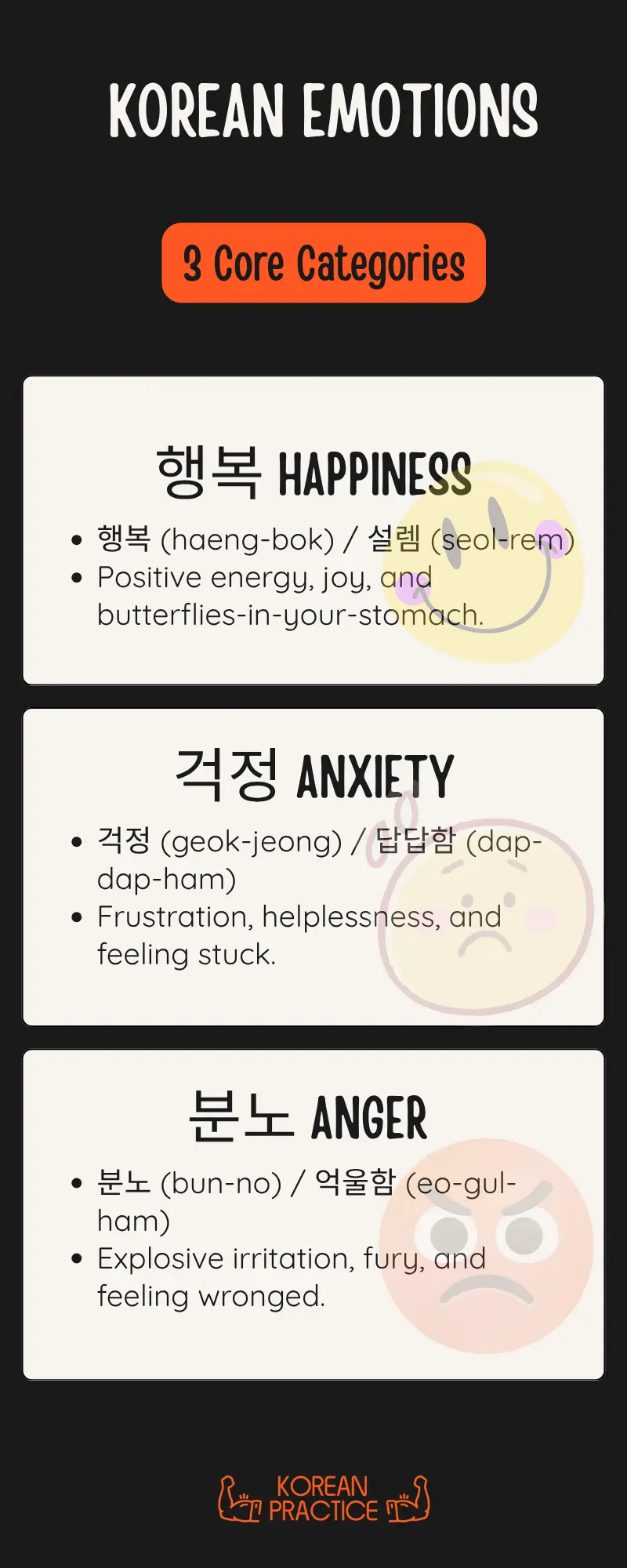
Instead of memorizing a flat, boring list of vocabulary, we are going to group these expressions into 3 Core Categories: Happiness (행복), Anxiety (걱정), and Anger (분노).
Segmenting words by their emotional “sub-drawers” will help your brain build immediate contextual connections, making them incredibly easy to recall in real-life conversations.
1. HAPPINESS (행복)
Koreans tend to view emotional expression through the lens of interpersonal harmony and relationship dynamics.
High-energy outbursts of individual joy are often toned down in public to avoid standing out, while shared, relational happiness is deeply cherished.
To sound natural, you need to match your expression to whether the joy is internal, shared, or anticipating a bond.
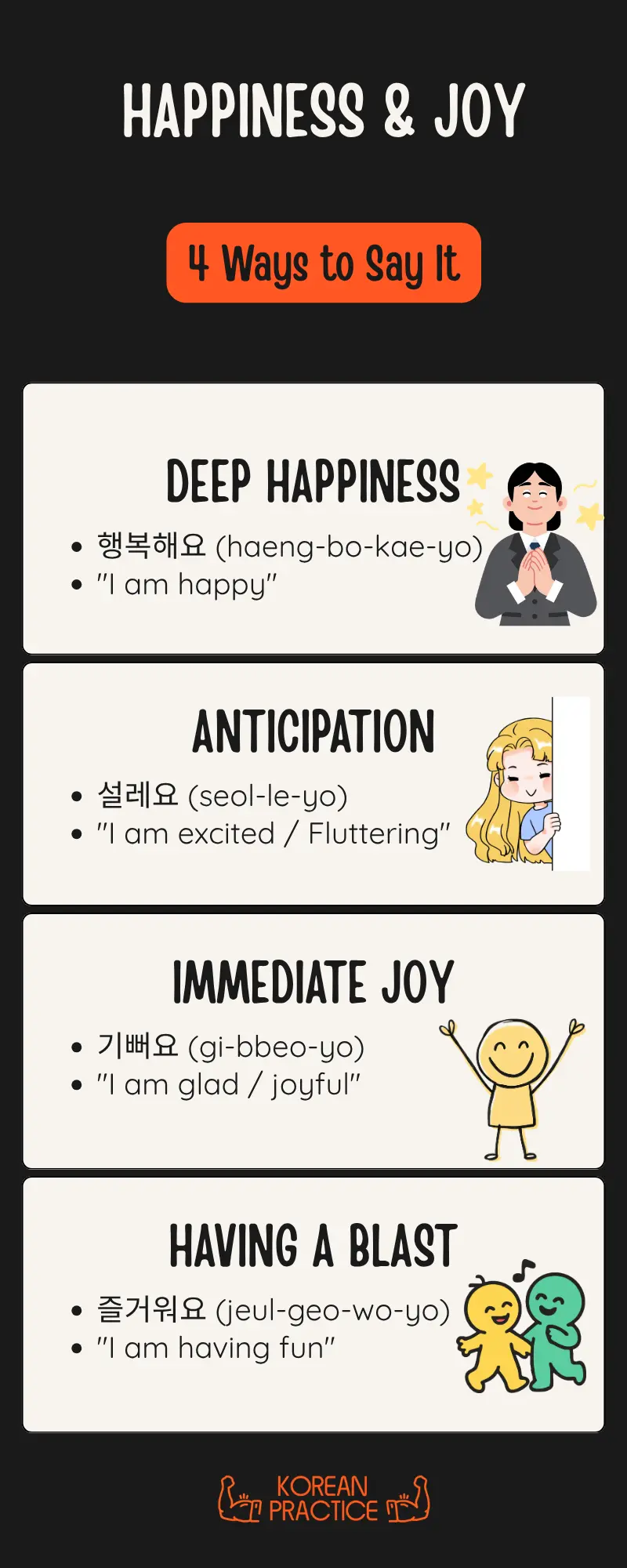
1-1 행복해요 (haeng-bo-kae-yo) – “I am happy”
Used for deep, stable, and long-lasting happiness or gratitude, often shared with family, partners, or friends.
Original Korean Sentence
오늘은 내 생일이라서 행복해요.
Pronunciation Guide
오늘은 (o-neu-reun) 내 (nae) 생일이라서 (saeng-i-ri-ra-seo) 행복해요 (haeng-bo-kae-yo).
Meaning and Context
오늘 (today) 은 (my topic is today) 내 (my) 생일 (birthday) 이라서 (because) 행복하 (to be so happy) 해요 (am; I’m telling you polite and friendly).
English Translation
I’m so happy today because it’s my birthday.
Literal Translation
(I)’m so happy because today is my birthday.
1-2 설레요 (seol-le-yo) – “I am excited / Fluttering”
The magical, butterflies-in-your-stomach feeling you experience before an exciting event, a big trip, or a special date.
Original Korean Sentence
내 생일 파티가 다가오니까 설레요.
Pronunciation Guide
내 (nae) 생일 (saeng-il) 파티가 (pa-ti-ga) 다가오니까 (da-ga-o-ni-gga) 설레요 (seol-le-yo).
Meaning and Context
내 (my) 생일 (birthday) 파티 (party) 가 (my subject is my birthday party) 다가오 (to approach) 니까 (as) 설레 (to be excited) 어요 (am; I’m telling you polite and friendly). * 설레 + 어요 = 설레요
English Translation
I’m excited as my birthday party is approaching.
Literal Translation
(I)’m excited as my birthday party approach.
1-3 기뻐요 (gi-bbeo-yo) – “I am glad / joyful”
Pure, sudden joy triggered by an immediate event, such as receiving great news, passing an exam, or getting a gift.
Original Korean Sentence
선물을 받아서 기뻐요.
Pronunciation Guide
선물을 (seon-mu-reul) 받아서 (ba-da-seo) 기뻐요 (gi-bbeo-yo).
Meaning and Context
선물 (gift) 을 (my object is a gift) 받 (to receive) 아서 (because) 기쁘 (to be happy) 어요 (am; I’m telling you polite and friendly). * 기쁘 + 어요 = 기뻐요
English Translation
I’m happy because I received a gift.
Literal Translation
(I)’m happy because (I) receive gift.
1-4 즐거워요 (jeul-geo-wo-yo) – “I am having fun”
Expresses that you are genuinely enjoying yourself during an active experience, an event, or a lively party.
2. ANXIETY (걱정)
In Korean psychology, anxiety is deeply tied to the pressure of societal expectations, the speed of daily life (the Pali-Pali culture), and the fear of causing a nuance of discomfort to others.
Negative internal states are often felt as a physical weight or blockage, which heavily influences how these feelings are expressed.
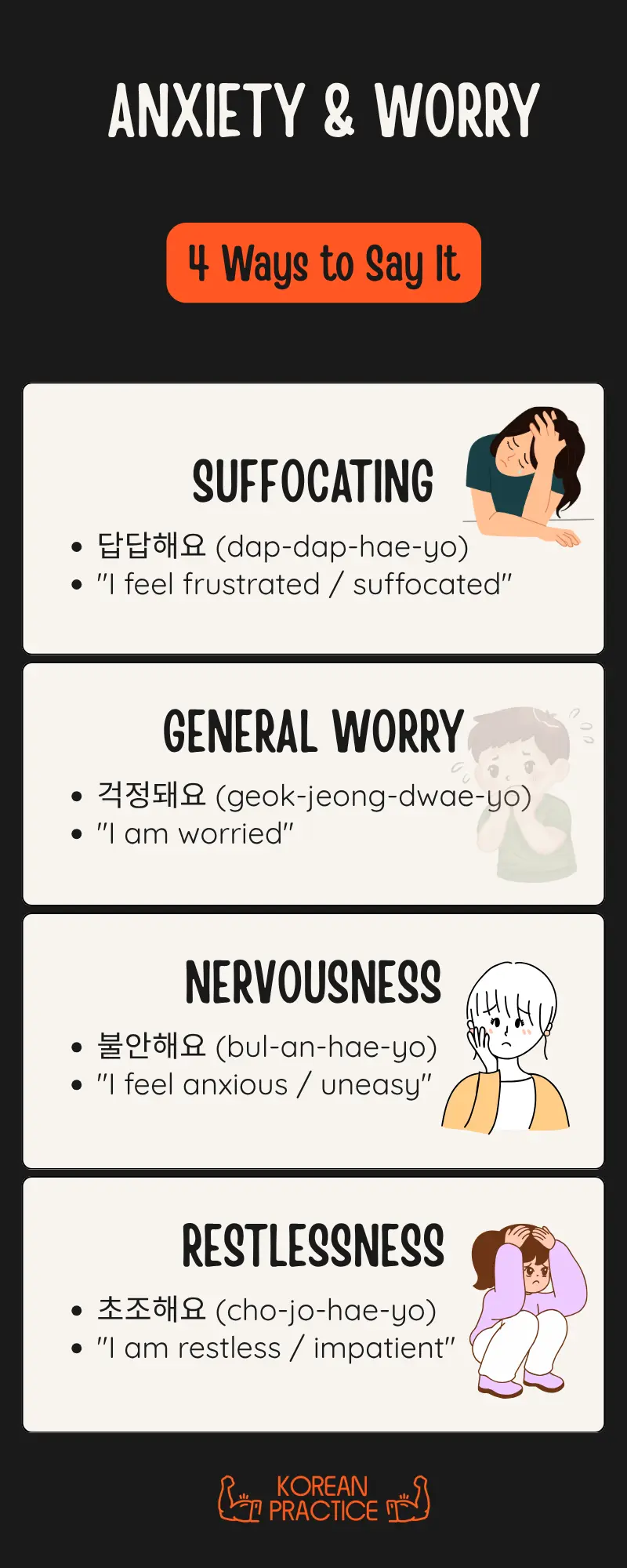
2-1 답답해요 (dap-dap-hae-yo) – “I feel frustrated / suffocated”
The heavy sensation when things don’t go your way, or when your Korean won’t come out and you feel utterly trapped.
Original Korean Sentence
제 생각을 잘 표현하지 못해서 답답해요.
Pronunciation Guide
제 (je) 생각을 (saeng-ga-geul) 잘 (jal) 표현하지 (pyo-hyeon-ha-ji) 못해서 (mot-tae-seo) 답답해요 (dap-dap-hae-yo).
Meaning and Context
제 (my; in a humble way) 생각 (thoughts) 을 (my object is my thoughts) 잘 (well) 표현하 (to express) 지 못하 (can not) 해서 (because) 답답하 (to feel frustrated) 해요 (I’m tellling you polite and friendly).
English Translation
I feel frustrated because I can’t express my thoughts well.
Literal Translation
(I) feel frustrated because (I) can’t express my thoughts well.
2-2 걱정돼요 (geok-jeong-dwae-yo) – “I am worried”
General worry or unease when thinking about potential future problems, such as upcoming exams, weather, or health.
Original Korean Sentence
걱정돼요. 내일의 날씨가 좋지 않을 것 같아요.
Pronunciation Guide
걱정돼요 (geok-jeong-dwae-yo). 내일의 (nae-i-re) 날씨가 (nal-ssi-ga) 좋지 (jot-chi) 않을 (a-neul) 것 (ggeot) 같아요 (ga-ta-yo).
Meaning and Context
걱정되 (to be worried) 어요 (am; I’m telling you polite and friendly). 내일 (tomorrow) 의 (‘s) 날씨 (weather) 가 (my subject is tomorrow’s weather) 좋 (to be good) 지 않 (not) 을 것 같 (I am guessing in a weak and soft way about the future or something that is likely to happen) 아요 (I’m telling you polite and friendly).
English Translation
I’m worried. It seems like tomorrow’s weather won’t be good.
Literal Translation
(I)’m worried. (It) seems like tomorrow’s weather won’t be good.
2-3 불안해요 (bu-ran-hae-yo) – “I feel anxious / uneasy”
A deeper, psychological anxiety where you feel unsafe, unstable, or plagued by an uncomfortable gut feeling.
Original Korean Sentence
오늘이 시험이라서 불안해.
Pronunciation Guide
오늘이 (o-neu-ri) 시험이라서 (si-heo-mi-ra-seo) 불안해 (bu-ran-hae).
Meaning and Context
오늘 (today) 이 (I’m going to talk about today) 시험 (exam) 이라서 (because) 불안하 (to be anxious) 해 (am; I’m telling you casually).
English Translation
I’m anxious because of the exam today.
Literal Translation
(I)’m anxious because today is exam.
2-4 초조해요 (cho-jo-hae-yo) – “I am restless / impatient”
The high-suspense restlessness you feel when running out of time, or when waiting helplessly for urgent results.
Original Korean Sentence
시간이 없어서 초조해요.
Pronunciation Guide
시간이 (si-ga-ni) 없어서 (eop-sseo-seo) 초조해요 (cho-jo-hae-yo).
Meaning and Context
시간 (time) 이 (my subject is time) 없 (there is no) 어서 (because) 초조하 (to feel uneasy) 해요 (I’m telling you polite and friendly).
English Translation
I feel uneasy because there’s not enough time.
Literal Translation
(I) feel uneasy because there’s no time.
3. ANGER (분노)
In Korean communication and K-dramas alike, anger surfaces as a multifaceted sentiment.
It is rarely just about being “mad.” It splits cleanly based on whether the frustration comes from an external unfairness or a sudden boundary violation.
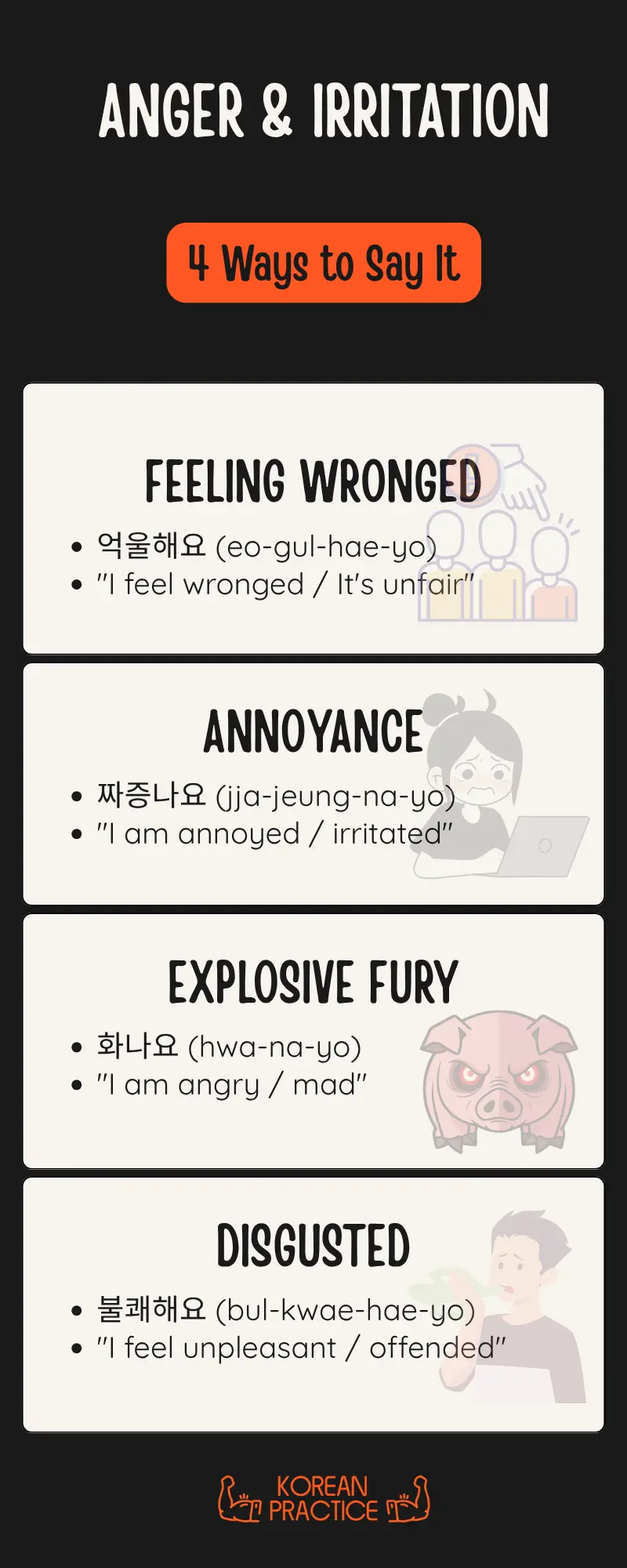
3-1.억울해요 (eo-gul-hae-yo) – “I feel wronged / It’s unfair”
A profound, painful mix of anger and sadness when you are falsely blamed, misunderstood, or treated unfairly for something you didn’t do.
Original Korean Sentence
열심히 일했는데 인정받지 못해서 억울해요.
Pronunciation Guide
열심히 (yeol-sim-hi) 일했는데 (il-haet-neun-de) 인정받지 (in-jeong-bat-ji) 못해서 (mot-tae-seo) 억울해요 (eo-gul-hae-yo).
Meaning and Context
열심히 (hard) 일하 (to work) 했 (past tense) 는데 (so; I’m in that situation) 인정받 (to be recognized) 지 못하 (can not) 해서 (because) 억울하 (to feel unfair) 해요 (is; I’m telling you polite and friendly). 일하 -> 일해, 못하 -> 못해, * 억울하 -> 억울해,
English Translation
I worked really hard, so it’s unfair that I didn’t get recognized.
Literal Translation
(I) worked hard, so (it)’s unfair because (I) can not be recognized.
3-2 짜증나요 (jja-jeung-na-yo) – “I am annoyed / irritated”
Spontaneous irritation caused by nagging external friction, like slow internet connection, extreme heat, or heavy traffic.
Original Korean Sentence
너무 소음이 심해서 짜증나요.
Pronunciation Guide
너무 (neo-mu) 소음이 (so-eu-mi) 심해서 (sim-hae-seo) 짜증나요 (jja-jeung-na-yo).
Meaning and Context
너무 (too) 소음 (noise) 이 (my subject is noise) 심하 (to be severe) 해서 (because) 짜증나 (to be annoyed) 아요 (am; I’m telling you polite and friendly). 하 -> 해, 짜증나 + 아요 = 짜증나요
English Translation
I’m annoyed because noise is so loud.
Literal Translation
(I)’m annoyed because noise is too severe.
3-3 화나요 (hwa-na-yo) – “I am angry / mad”
The baseline expression for being genuinely angry, upset, or losing your temper over an offensive situation.
Original Korean Sentence
그 일 때문에 화나요.
Pronunciation Guide
그 (geu) 일 (il) 때문에 (ddae-mu-ne) 화나요 (hwa-na-yo).
Meaning and Context
그 (that) 일 (incident) 때문에 (because of) 화나 (to be angry) 아요 (am; I’m telling you polite and friendly). * 화나 + 아요 = 화나요
English Translation
I’m angry because of that incident.
Literal Translation
(I)’m angry because of that incident.
3-4 불쾌해요 (bul-kwae-hae-yo) – “I feel unpleasant / offended”
A cold, defensive anger triggered when someone crosses your personal boundaries, speaks rudely, or makes you feel deeply uncomfortable.
Original Korean Sentence
그 사람과 대화하면 불쾌해요.
Pronunciation Guide
그 (geu) 사람과 (sa-ram-gwa) 대화하면 (dae-hwa-ha-myeon) 불쾌해요 (bul-kwae-hae-yo).
Meaning and Context
그 (that) 사람 (person) 과 (with) 대화하 (to talk) 면 (if) 불쾌하 (to feel unpleasant) 해요 (I’m telling you polite and friendly).
English Translation
I feel unpleasant when I talk to that person.
Literal Translation
(I) feel unpleasant if (I) talk with that person.

FAQs (What You Might Still Wonder About)
1. How do Koreans express happiness differently from English speakers?
When learning happy in Korean, it helps to know that Koreans often express happiness indirectly through tone or context rather than only saying “기뻐요.” For example, phrases like “좋네요!” or “완전 좋아!” can sound more natural in daily conversation.
2. Are there cultural differences in how people express feelings in Korean?
Yes. Many Koreans soften their emotions to maintain harmony. Instead of directly expressing anger or sadness, they may use gentle Korean phrases for emotions such as “좀 속상해요” (I’m a bit upset) to avoid sounding too strong.
3. What’s the easiest way to learn Korean emotion words without memorizing long lists?
Group the vocabulary by feelings—positive, negative, or subtle emotions. This helps your brain build connections, making Korean emotion words easier to remember and use naturally.
4. Why do some Korean feeling words have multiple meanings?
In Korean, context determines meaning. For example, 부끄럽다 can mean embarrassed, shy, or even bashful, depending on the situation. This flexibility is common in feelings in Korean, so look at the whole sentence rather than translating word by word.
5. What is the difference between emotions and moods in Korean?
Emotions (감정) describe immediate reactions like anger or happiness, while moods (기분) describe a long-lasting state. That’s why you say 기분이 좋아요 (I’m in a good mood) instead of 감정이 좋아요.
6. Why do Koreans often add sound effects when expressing emotions?
In Korean conversation, emotional sound expressions like 헐, 아싸, 아이구, or 에이 often carry more emotional weight than full sentences. These add nuance and help express subtle feelings in Korean that might not translate directly into English.
Final words
In conclusion, mastering emotions in Korean is an essential part of effective communication.
By understanding cultural differences, learning emotional vocabulary, and using the right tone and body language, you can effectively express a wide range of emotions in Korean.
With the phrases we’ve provided, you’ll be well on your way to expressing.